


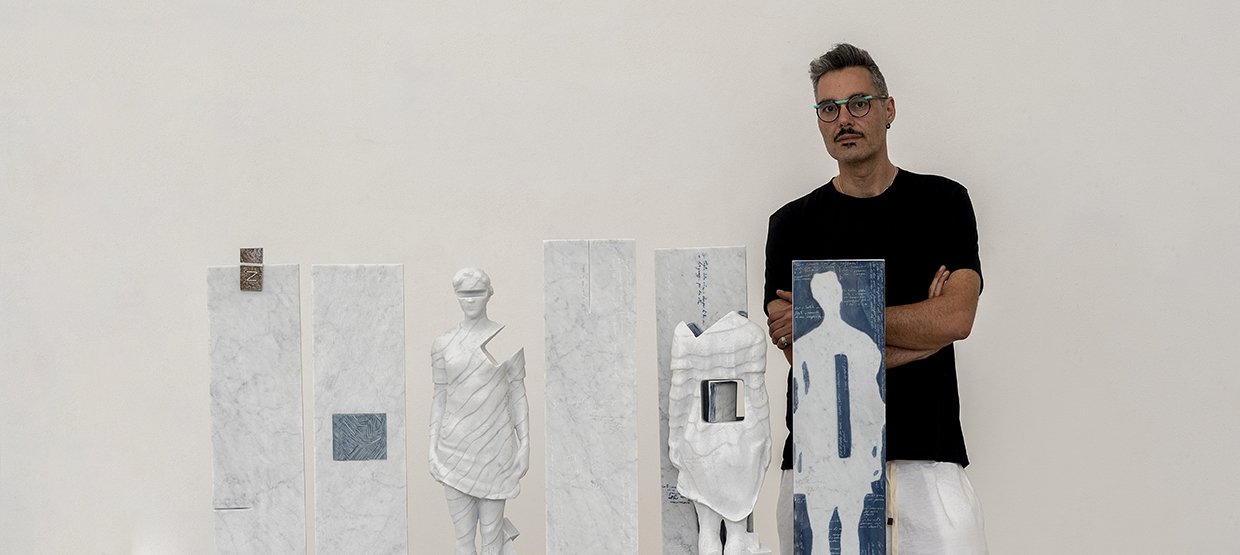
Vincenzo Muratore at Litix: Art Residency in the heart of Carrara’s marble
Artist Vincenzo Muratore recently concluded his residency at Litix spa, a company in Massa Carrara (Italy), the historic city where one of the world’s most precious materials is mined: Carrara marble. The residency was created after the Special Prize of Arte Laguna Prize 20th edition created in collaboration with the Tuscan company.
Litix offered its laboratory, a block of marble, and its advanced robotics technologies to create—together with the artist—an original and unique work of art.
To learn more about the experience, we interviewed artist Vincenzo Muratore.
THE INTERVIEW
What was your first encounter with this organization? What convinced you to apply for their Special Prize?
I already knew Litix by name; I’d often gone to Carrara to work, and their reputation preceded their work. But I’d never had the opportunity to collaborate with them directly or get to know them in depth. When I read the call for proposals, I immediately felt a resonance with my current practice: there was something truly similar, not just technically but conceptually. It was the opportunity to work with an excellent team in a context that could truly push research forward. I didn’t think about it for long. I came across this opportunity at a time when I was looking for a place where technology could become a real interlocutor, not a tool. My research has always revolved around a specific idea: revealing by withholding, showing by concealing. I needed a laboratory that understood this tension, and Litix understood it immediately. The team is highly professional yet deeply human; they welcomed me and supported me, and that’s not a given. And then there’s the landscape: every morning, the journey from the center of Carrara to the laboratory, through woods and the white patches of mountain quarries, is an experience in itself. You arrive at the laboratory at seven o’clock with your eyes already filled with marble and light.
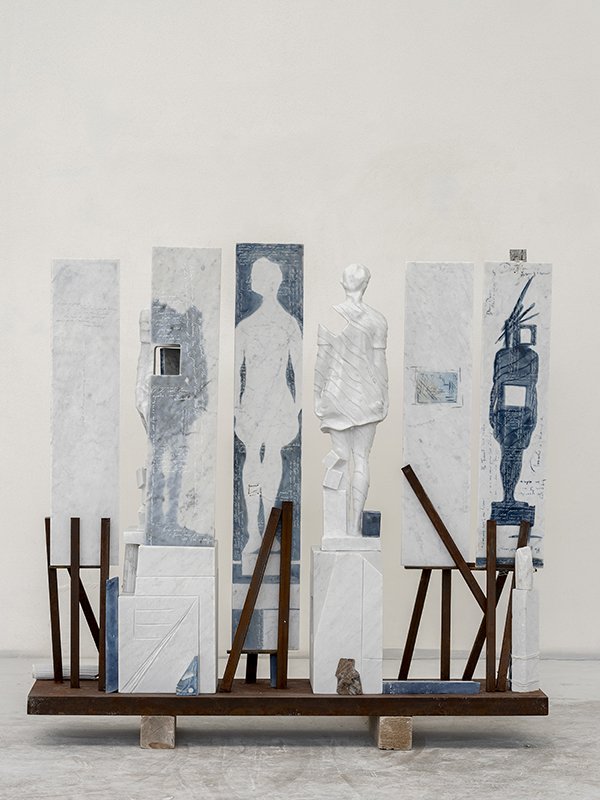
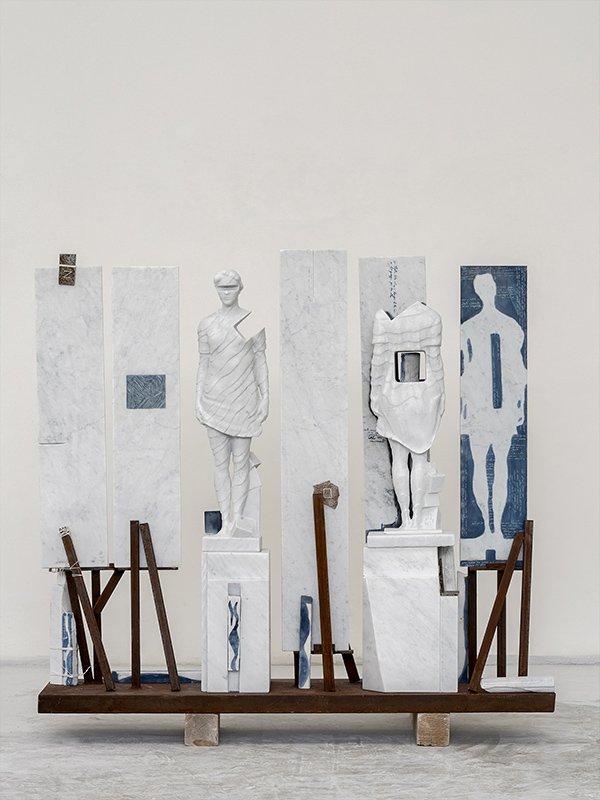
ECHOES OF PRESENCE, 2025
Steel, cyanotype on Carrara marble, graphite and cotton stitching
150 x 90 x 35 cm
During your residency, you created a marble work. Can you tell us more about its creation and meaning, including the techniques Litix offers?
The original project was very ambitious: numerous figures inspired by the work of Pina Bausch, by that extraordinary idea of telling without showing, of letting nature complete the gesture. But after an honest discussion with the Litix team, I chose to modify it, to concentrate it. It was one of the best decisions of the residency: the reduction made everything more powerful.
The final system blends marble, metal, fabric, and cyanotype in a language where absence becomes presence. The figures are never shown in their entirety. They are echoes, silhouettes, shadows fixed by sunlight. The very structure of the work works by subtraction: what is not seen weighs as much as what is seen, sometimes more. The words intertwine between pencil and engraving, between surface and depth. Some will disappear over time, consumed by light and air. Others will appear only years later, when the stone has decided to reveal them. The work does not end with me; it continues to hide and reveal at its own pace.
A key element is the recycling of the marble: every fragment eliminated during the process, milling waste, and supporting pieces, was reincorporated into the final sculpture. Nothing is lost. Even the waste materials carry a story; they have already encountered the machine and the hands. Remaining in the work was their natural place.
Was there a moment during the residency when the dialogue with technology or the material surprised you or took you in a direction you hadn’t foreseen?
There were two moments that surprised me, and neither was predictable. The first concerned the cyanotype on marble. I already knew that the technique responds to light, but I didn’t know how much the marble itself would be involved in the process. Each slab has a different chemical composition and porosity: the cyanotype reads them all, veering toward unchosen nuances, producing tones that exist on no other surface. It’s not about printing on marble; it’s the marble that decides how much light to retain and how much to reflect. I had to learn to relinquish control. And in that surrender, I found exactly the principle I was looking for: the material reveals what the hand could never impose.
The second moment was even more intimate. On one of the pieces, I chose to leave the lines left by the robotic milling machine visible, and in some sections I replicated them by hand, with the same trajectory, the same rhythm. I tried to do what the machine had done. It was an exercise in deep listening: understanding how technology conceives space, how it organizes the surface. That piece became a tribute to robotics. I don’t hide the use of technology, but I narrate it in a place where human and mechanical gestures mirror each other, hiding within each other, and it’s not always clear who left what mark.
What did Litix give you that you can bring into your future career as a sculptor?
I will bring a discovery that deeply affected me: only 1% of the marble extracted is used for artistic creation. The dominant narrative says the opposite, often mystifying marble and stone as disruptive elements in the contemporary art scene, almost as if they were an anachronistic luxury. The reality is that almost all of the extracted material ends up in the construction and cosmetics industries. Knowing this has pushed me to greater awareness and to continue with even greater conviction to use processing waste as the basis for my works. It’s not a romantic gesture: it’s a position.
I will bring an understanding of marble as a living subject. Not a support, but a breathing protagonist, who reacts, who chooses how much to reveal. I will bring a more precise method: the technology that opens the surface, the chemistry that inhabits it, the time that transforms, the hand that listens and intervenes where necessary. And I will bring the awareness that concealment is not the absence of communication, but its most dense form. Litix gave me the tools to delve deeper into this grammar, and the generosity of a team that supports you without overwhelming your thinking.
The experience of Litix and the artist
It was a truly beautiful experience, from every perspective.
The resulting work speaks for itself: Vincenzo worked on slabs of white Carrara marble transformed into a cyanotype surface—a 19th-century photographic process imprinted directly onto the stone—and from those same slabs he created figures sculpted with ROBOTOR technology. The dialogue between the blue trace and the three-dimensional form is precise, conceptually solid, and visually powerful. This isn’t a work that can be improvised: there’s a clear idea behind it, and the technical mastery to bring it to fruition. The experimentation with cyanotype on marble, in particular, is something we’ve never seen done here—and the result surprised even us.
But if I had to say what made this residency truly special, it was Vincenzo the man. Discreet, curious, respectful of every corner of the workshop and those who work there every day. He left a handwritten thank you note for the entire staff—a small but rare gesture, which was greatly appreciated by everyone. We will remember it.
We are proud that the Special Prize has brought an artist of this caliber here.– F. Tincolini (CEO)
There’s something extraordinary about working at dawn, in a warehouse in the mountains of Carrara, knowing that outside lie quarries that have been supplying the world with marble for millennia. It’s not nostalgia, it’s continuity. I arrived with digital files, CNC milling machines, photosensitive emulsions. But the gesture was ancient: removing to reveal, marking to remember, letting the stone carry what we don’t yet know how to express. Concealment and revelation are not oppositions; they are the breath of the same work. That morning at seven o’clock, with the coffee still hot and the white mountains outside the window, was always a good place to start.
– V. Muratore (Artist)
Photo by: Laura Veschi